Word Association - Ice Breaker Game
🎯 Quick Summary
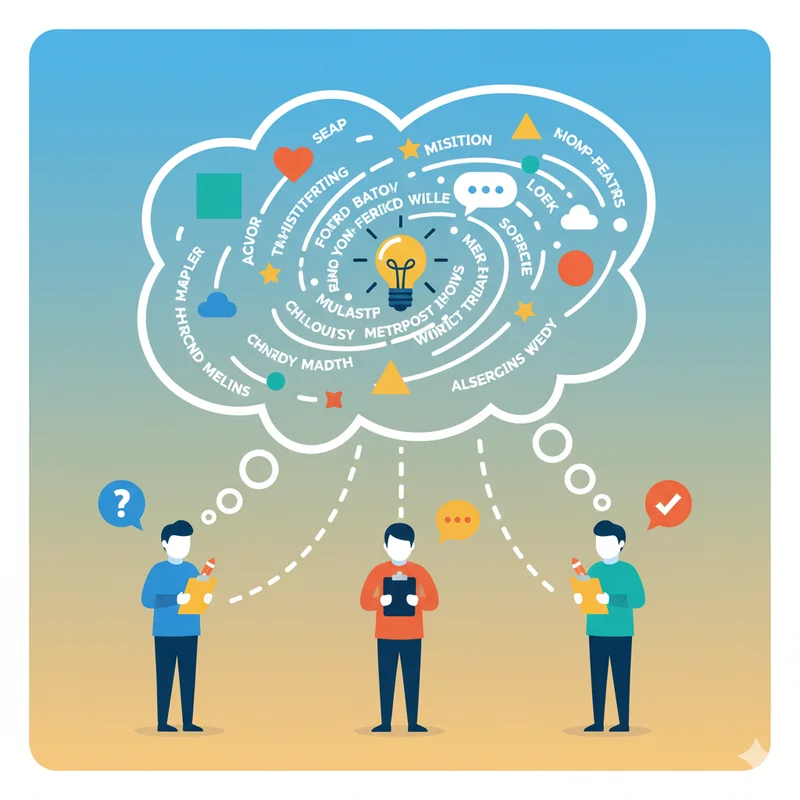
Players write the first word that comes to mind for each prompt, revealing thinking patterns and connections.
✅ Why This Ice Breaker Game Works
- •This ice breaker has been used by 2,559 teams worldwide
- •Rated 4.2/5.0 by 197 facilitators who used this icebreaker game
- •Perfect ice breaker for: Fun, Team Building, Deep Talk
📝 How to Play Word Association Ice Breaker (Step-by-Step)
Step 1: Setup & Instructions
3 min💬 Say This:
"Welcome to Word Association! This is a quick brain game that shows how we all think differently. I'm going to read 10 words, one at a time. As soon as you hear each word, write down the FIRST thing that comes to your mind. Don't think too hard - we want your instant, gut reaction. Ready? Everyone write numbers 1 through 10 on your paper. Let's begin!"
📋 What to Do:
- 1.Prepare a list of 10 words in advance (see examples below)
- 2.Alternatively, use a random word generator for spontaneity
- 3.Have participants write numbers 1-10 on their paper
- 4.Explain the rules clearly:
- 5. - Listen to each word
- 6. - Write down the FIRST thing that comes to mind
- 7. - No overthinking, no erasing, no changing answers
- 8. - Speed matters - go with your gut
- 9.Emphasize: there are no right or wrong answers
- 10.Read the first word and give participants 5-10 seconds to write
- 11.Continue through all 10 words at a steady pace
💡 Pro Tips:
- •Good word choices: mix concrete nouns (ocean, tree, book) with abstract concepts (freedom, success, fear) and action words (run, dance, create)
- •Read clearly and at a steady pace - not too fast, not too slow
- •Watch for people overthinking - remind them: 'First thought only!'
- •Virtual teams: type words in chat or display on screen one at a time
- •Example word lists: (1) ocean, mountain, fire, sky, storm, river, desert, forest, wind, earth (2) love, fear, joy, anger, hope, dream, memory, future, peace, chaos
- •Keep words neutral and work-appropriate
Step 2: Sharing & Comparing
15 min💬 Say This:
"Alright, let's see how your minds work! Let's go word by word. For Word 1, which was '[first word]', what did everyone write? [Go around the group] Interesting! So we have [list responses]. Why such different associations? [Invite 1-2 people to explain] Let's move to Word 2..."
📋 What to Do:
- 1.Go through each word one at a time
- 2.For each word, have everyone share what they wrote
- 3.Notice patterns: did anyone write the same thing? Completely different things?
- 4.After hearing all responses for a word, ask 1-2 people: 'Why did you write that? What's the connection?'
- 5.Encourage brief explanations of reasoning
- 6.Point out interesting contrasts: 'Half of you went positive, half negative!' or 'Some of you thought of objects, others of emotions'
- 7.Continue through all 10 words (or as many as time allows)
- 8.Keep the pace moving - don't get too bogged down in explanations
💡 Pro Tips:
- •The comparisons are where the insights emerge!
- •Listen for: personal experiences ('I wrote 'beach' because I grew up near the ocean'), cultural differences, optimistic vs. pessimistic thinking
- •Celebrate uniqueness: 'No one else wrote that! Tell us more!'
- •Also highlight commonalities: 'Four people wrote 'blue' - interesting!'
- •Some associations will be literal ('tree' → 'wood'), others abstract ('tree' → 'family tree') - both are revealing
- •If someone's association seems random, ask them to explain - there's always a logic!
- •Watch for: introverts might have more introspective associations, extraverts more action-oriented
Step 3: Reflection & Insights
2 min💬 Say This:
"What a range of associations! What did you notice about how we all think differently? Did anyone surprise you with their response? What does this tell us about working together as a team? When we understand how each other's minds work, we collaborate better!"
📋 What to Do:
- 1.Facilitate brief reflection on the activity
- 2.Ask: 'What surprised you about someone's associations?' 'Whose thinking is most similar to yours? Most different?'
- 3.Connect to teamwork: 'How does understanding different thinking styles help us work together?'
- 4.Point out any patterns you noticed: 'Visual thinkers, emotional thinkers, logical thinkers - we have a mix!'
- 5.Optional: discuss how word associations relate to brainstorming and creativity in work
- 6.Thank everyone for sharing their thought processes
💡 Pro Tips:
- •The real value: understanding that people process information differently
- •Great insight: 'In brainstorming, some of us will think literally, others metaphorically - both are valuable!'
- •Point out complementary thinking: 'Detail-oriented thinkers balance big-picture thinkers'
- •If you noticed interesting patterns (e.g., several people associate words with colors, others with sounds), highlight them
- •Follow-up: in future meetings, reference this when discussing perspectives: 'Remember Word Association - we all see things differently!'
- •The activity also reveals shared cultural references and experiences
⚠️ Common Questions (Avoid Problems)
Q: What if someone can't think of anything for a word?
A: Encourage them to write ANYTHING - even if it seems silly or unrelated. Say: 'If you're stuck, write the first sound, color, or feeling that comes up. There's no wrong answer!' The 'I don't know' reaction is itself interesting - it might mean the word is triggering deeper thought or is less familiar. If they're truly blank, they can write 'blank' or 'nothing' and explain why later.
Q: What if someone writes something inappropriate or offensive?
A: This is rare if you've chosen neutral words, but it can happen. Set ground rules upfront: 'Keep it work-appropriate!' If someone does share something questionable, gently redirect: 'Let's keep it professional' and move on quickly. Choose your word list carefully to avoid triggering controversial associations (avoid words like 'politics', 'religion', 'money' in work settings).
Q: Can we play this activity multiple times with the same group?
A: Yes, but use different word lists each time! The novelty is key. You can also add twists: (1) Round 1: use concrete nouns, Round 2: use abstract concepts, (2) Theme the words: all nature words, all emotion words, all work-related words, (3) Challenge mode: use very obscure or made-up words and see what associations emerge. The format is repeatable, but fresh words keep it engaging.
🎁 Free Tools for This Game
💼 Need It Ready Faster? Pro Tools Save 3+ Hours
Everything above is free. These tools just save you time preparing.
PDF Handout
Print-ready participant guide + host notes
✓ Professional layout
✓ Branded (optional)
✓ Instant download
PPT Deck
Editable slides with rules & examples
✓ Fully customizable
✓ Add your branding
✓ Save as template
Smart Timer
Auto-paced with sound alerts
✓ Step-by-step timing
✓ Visual countdown
✓ Share screen ready
Adapt this game to your team culture, industry, or goals
Export clean files without FreeIceBreaker branding
Then just $9/month • Cancel anytime
⭐ 2,391 teams upgraded • "Saved me 3 hours every month" - Sarah K.