The Marshmallow Challenge - Ice Breaker Game
🎯 Quick Summary
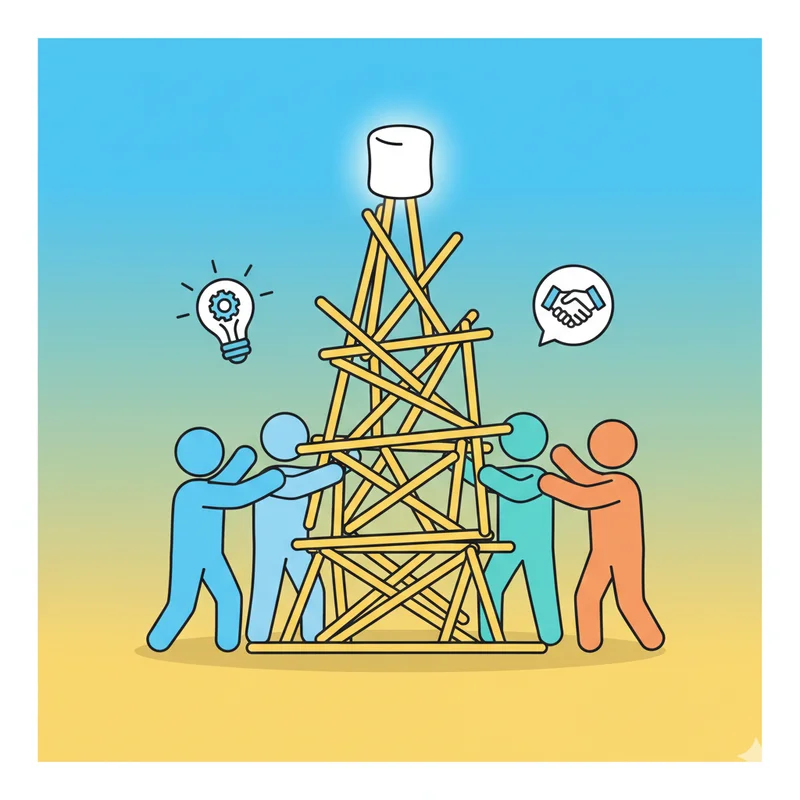
Teams build the tallest spaghetti tower with a marshmallow on top in 18 minutes, testing creativity and collaboration.
✅ Why This Ice Breaker Game Works
- •This ice breaker has been used by 1,416 teams worldwide
- •Rated 4.6/5.0 by 198 facilitators who used this icebreaker game
- •Perfect ice breaker for: Team Building, Creative
📝 How to Play The Marshmallow Challenge Ice Breaker (Step-by-Step)
Step 1: Setup & Rules Briefing
10 min💬 Say This:
"Welcome to the Marshmallow Challenge! Your mission: build the TALLEST free-standing structure you can in 18 minutes using only these materials [show kit]. The marshmallow must be on top, and the structure must stand on its own when time ends. You can break the spaghetti, cut the tape and string, use as much or as little as you want. But - you cannot eat the marshmallow, and you cannot support the structure with your hands when time's up. Ready? Let's build!"
📋 What to Do:
- 1.Set up one table per team with materials: 20 spaghetti sticks, 1 yard tape, 1 yard string, 1 marshmallow
- 2.Form teams of 4 participants each (can work with 3-5 if needed)
- 3.Explain the rules clearly and repeat at least 3 times:
- 4. - Goal: tallest FREE-STANDING structure (measured from table to top of marshmallow)
- 5. - Time limit: 18 minutes
- 6. - Marshmallow MUST be on top (entire marshmallow, not cut)
- 7. - Can break/cut spaghetti, tape, and string as needed
- 8. - Structure must stand on its own when time ends (no hands supporting)
- 9. - Cannot use the materials bag as part of structure
- 10. - Teams touching/supporting structure at end are disqualified
- 11.Invite clarifying questions before starting
- 12.Display countdown timer visibly
💡 Pro Tips:
- •Emphasize: 'The marshmallow is heavier than you think!' (this is the key challenge)
- •Play upbeat music during the build to create energy
- •Repeat the rules multiple times - people will ask again!
- •Have extra materials on hand in case of mistakes (broken spaghetti, tangled string)
- •Virtual option: ship kits to remote participants beforehand, or use a digital simulation
- •The briefing is EVERYTHING - clarity here prevents disputes later
Step 2: Build Time (18 Minutes)
18 min💬 Say This:
"[Start timer] Your 18 minutes starts NOW! Remember: prototype early and often. Test your structure before the end! [Throughout: provide commentary] 'Team 3 is testing their design - smart move!' 'Team 1 going for a tripod base - interesting!' [At milestones] '10 minutes left!' '5 minutes!' '1 minute - final touches!' [At end] 'Time's up! Hands off the structures! Let them stand or fall on their own!'"
📋 What to Do:
- 1.Start the 18-minute timer prominently
- 2.Teams begin building immediately
- 3.As facilitator, circulate and observe (but don't help or give hints)
- 4.Provide time warnings: 10 min left, 5 min, 2 min, 1 min, 30 seconds, 10 seconds countdown
- 5.Watch for rule violations (eating marshmallow, using bag, etc.) and gently remind
- 6.Take photos/videos of teams in action for later debrief
- 7.At 18 minutes, call 'TIME'S UP! HANDS OFF!' and ensure no one is touching structures
- 8.Allow 30 seconds for structures to settle and stabilize (or collapse!)
💡 Pro Tips:
- •Hype up the energy: 'Team 2 has a bold strategy!' 'Who will test their structure first?'
- •Most teams will plan for 15 minutes then rush to build at the last minute - this usually fails!
- •The best teams prototype early: build, test, fail, iterate, improve
- •Watch for interesting dynamics: who takes leadership? Who's quiet? Who grabs materials?
- •Many structures will collapse at the end when the marshmallow is added - that's the lesson!
- •If a team asks 'Can we...?', refer back to the rules you already explained (don't give extra help)
- •The marshmallow's weight is the killer - most people underestimate it
Step 3: Measurement & Debriefing
25 min💬 Say This:
"Let's measure! [Measure each structure from table to top of marshmallow, announce heights] And the winner is... Team [X] with [X] inches! But wait - the real prize is what we learned. Let's debrief. First, take 5 minutes alone to reflect: What was your team's strategy? What was YOUR role? What worked? What would you change? [After reflection] Now share within your team for 10 minutes. Then we'll discuss as a whole group."
📋 What to Do:
- 1.Have all teams sit so everyone can see all structures
- 2.Measure each structure with measuring tape (table surface to top of marshmallow)
- 3.Announce heights and declare a winner
- 4.Celebrate the winning team but emphasize 'the real lessons are ahead'
- 5.Individual reflection (5 min): What was the strategy? What was my role? What worked? What would I improve?
- 6.Team sharing (10 min): Discuss what worked, what didn't, what you'd change next time
- 7.Optional Triad discussion (9 min, 3 rounds of 3 min): Groups of 3 from different teams discuss:
- 8. - What are the advantages of the role you usually take?
- 9. - What are the disadvantages?
- 10. - What learning would you take away?
- 11.Whole group debrief: Share insights, patterns, surprises
💡 Pro Tips:
- •The debrief is MORE IMPORTANT than the activity itself!
- •Key lessons: early prototyping beats perfect planning, marshmallow = real-world constraints, collaboration requires clear communication
- •Watch for: Who was the leader? Who built? Who planned? Who was ignored?
- •Common insights: 'We spent too long planning', 'We didn't test until the end', 'We didn't listen to each other', 'The marshmallow surprised us'
- •Ask: 'What does the marshmallow represent in real work?' (hidden requirements, unexpected challenges, assumptions)
- •Point out that kindergarteners often outperform business school students (they prototype, not plan!)
- •Connect to real work: How does your team plan vs. execute? Do you test early or wait until the deadline?
⚠️ Common Questions (Avoid Problems)
Q: Why do structures often collapse at the last minute?
A: Because teams underestimate the marshmallow's weight! Most spend 15+ minutes building a beautiful, tall structure, then add the marshmallow at the last second only to watch it collapse. The marshmallow is the 'hidden requirement' - like discovering a crucial constraint late in a real project. The lesson: test with the marshmallow EARLY and OFTEN, prototype rapidly, and iterate based on reality, not theory.
Q: Who typically does best at the Marshmallow Challenge?
A: Kindergarteners! Tom Wujec's research shows young children outperform business school students, lawyers, and other professionals. Why? Kids prototype immediately, test early, and iterate without ego. Adults over-plan, debate, assign roles, and wait until the end to build - then panic. Engineers and architects do well because they prototype. CEOs do well ONLY if they have an admin assistant on their team (interesting dynamic!). The lesson: build and test fast, don't overthink.
Q: What if my team gets frustrated or gives up?
A: That's valuable data! Some teams will hit a wall and declare 'This is impossible!' Encourage them to keep trying: 'What have you learned from your failures so far?' The frustration is part of the lesson - real innovation is hard, iteration is messy, failure is feedback. In the debrief, ask: 'How did you handle frustration as a team?' If a team truly gives up, that becomes a discussion point: 'What stops us from persevering in real work?'
🎁 Free Tools for This Game
💼 Need It Ready Faster? Pro Tools Save 3+ Hours
Everything above is free. These tools just save you time preparing.
PDF Handout
Print-ready participant guide + host notes
✓ Professional layout
✓ Branded (optional)
✓ Instant download
PPT Deck
Editable slides with rules & examples
✓ Fully customizable
✓ Add your branding
✓ Save as template
Smart Timer
Auto-paced with sound alerts
✓ Step-by-step timing
✓ Visual countdown
✓ Share screen ready
Adapt this game to your team culture, industry, or goals
Export clean files without FreeIceBreaker branding
Then just $9/month • Cancel anytime
⭐ 2,391 teams upgraded • "Saved me 3 hours every month" - Sarah K.