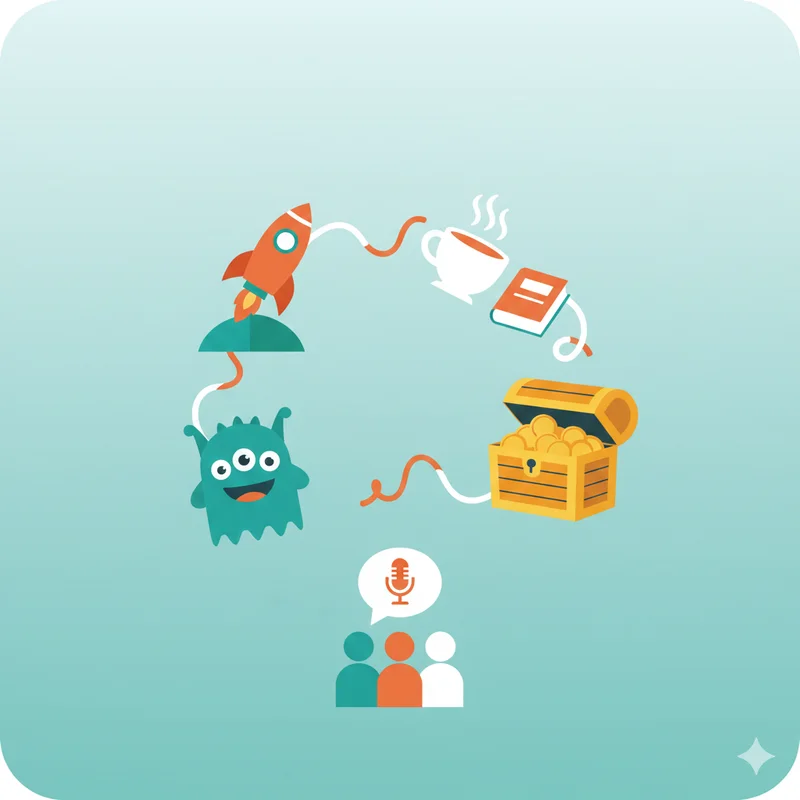
Storytelling Icebreaker - Ice Breaker Game
🎯 Quick Summary
Teams create cohesive stories connecting four random images, then present and receive feedback on their narratives.
✅ Why This Ice Breaker Game Works
- •This ice breaker has been used by 1,868 teams worldwide
- •Rated 4.2/5.0 by 191 facilitators who used this icebreaker game
- •Perfect ice breaker for: Creative, Team Building
📝 How to Play Storytelling Icebreaker Ice Breaker (Step-by-Step)
Step 1: Setup & Image Selection
5 min💬 Say This:
"Welcome to Storytelling Icebreaker! Your challenge today: create a story using these four images. They might seem random, but your job is to find the narrative thread that connects them. Work with your team, use your imagination, and remember - the best stories surprise us! Let's form teams and get your images."
📋 What to Do:
- 1.Divide participants into teams of 3-4 people
- 2.Select four diverse images in advance (examples: a coffee cup, a mountain, a clock, a dog; or: a city street, a balloon, an old book, a sunset)
- 3.Print copies of all four images for each team
- 4.Distribute image sets to each team
- 5.Explain the challenge: create one cohesive story that connects all four images in sequence
- 6.Emphasize: all four images must be incorporated - no skipping!
- 7.Set timer for 10 minutes
💡 Pro Tips:
- •Choose images that are diverse enough to challenge creativity but not impossible to connect
- •Mix concrete objects (cup, dog) with abstract concepts (sunset, emotion) for richer storytelling
- •Avoid images that are too similar or too obviously connected - that's too easy!
- •For virtual teams, share images in a slideshow or collaborative doc
- •Encourage teams to designate roles: one person sketches story flow, one takes notes, everyone contributes ideas
- •Remind them: there's no 'right' story - creativity matters most
Step 2: Story Creation & Development
15 min💬 Say This:
"You have 10 minutes to create your story! All four images must appear in your narrative. Think: What's the setting? Who are the characters? How do these images connect? Be creative, be bold, be surprising! I'll give you time warnings. Go!"
📋 What to Do:
- 1.Teams brainstorm and develop their stories (10 minutes)
- 2.Circulate to each team, listening and offering gentle encouragement
- 3.Give time warnings: '5 minutes left!' '2 minutes!' '30 seconds to finalize!'
- 4.Teams should decide: story structure (beginning/middle/end), how each image fits, who will present
- 5.Encourage teams to practice a quick run-through of their story before presenting
- 6.If a team finishes early, challenge them: 'Make it more surprising!' or 'Add more detail to the middle!'
💡 Pro Tips:
- •Watch for teams that struggle - offer prompts: 'What if one image is a memory? A dream? A clue?'
- •Some teams will go literal (all four images in one scene), others metaphorical (images represent themes) - both work!
- •Listen for creative connections: 'That's brilliant!' helps boost confidence
- •If a team says 'We can't connect them all,' challenge: 'There's always a way - think outside the box!'
- •Great stories often have a twist: the images mean something different than expected
- •Virtual tip: use breakout rooms for story creation, then return to main room for presentations
Step 3: Story Presentations & Feedback
15 min💬 Say This:
"Story time! Each team will present their narrative - show us how you connected all four images. After each presentation, we'll give feedback and suggestions. Remember: constructive and kind! Team 1, take it away!"
📋 What to Do:
- 1.Each team presents their story (2-3 minutes per team)
- 2.Teams can narrate, act out, or have one spokesperson tell the story
- 3.After each presentation, allow 1-2 minutes for questions and feedback from other teams
- 4.Encourage constructive suggestions: 'What if you expanded the middle part?' 'I loved the twist with the clock!'
- 5.After all presentations, facilitate a group vote or discussion to determine the best story
- 6.Criteria: creativity, coherence, surprise factor, engagement
- 7.Announce the winning team and celebrate all stories
💡 Pro Tips:
- •The presentations are hilarious - embrace the chaos!
- •Point out creative techniques: 'Team 3 used all the images in one scene - Team 2 spread them across time!'
- •If a story doesn't quite connect all images, be gentle: 'Almost there! How could the balloon tie into the ending?'
- •Celebrate unexpected connections: 'I never would have thought to link the clock and the dog like that!'
- •The 'losing' teams often have moments of brilliance - highlight those
- •Optional: award categories - 'Most Creative', 'Best Twist', 'Most Cohesive', 'Funniest'
⚠️ Common Questions (Avoid Problems)
Q: What if a team genuinely can't find a way to connect all four images?
A: Give them hints or a second chance. Say: 'Think metaphorically - could one image be a memory, a dream, or a symbol?' or 'What if the story spans different times or places?' If they're truly stuck after a retry, let them present a 3-image story and discuss as a group how the 4th could be added. The struggle itself teaches creative problem-solving!
Q: What types of images work best for this activity?
A: Mix concrete (objects, people, animals) with abstract (colors, patterns, emotions) and varied settings (indoor, outdoor, close-up, landscape). Avoid images that are too obviously connected (all beach photos) or too obscure (abstract art only). Good examples: a coffee cup + a mountain + a clock + a child's toy. The challenge should be 'hard but doable.'
Q: Can we play multiple rounds with different image sets?
A: Absolutely! If time allows, shuffle teams and give a new set of four images for round two. You can increase difficulty: round 1 = easier connections, round 2 = more abstract images. Or add constraints: 'This round, your story must be a mystery' or 'Include a surprise ending.' Multiple rounds let everyone refine their storytelling skills.
🎁 Free Tools for This Game
💼 Need It Ready Faster? Pro Tools Save 3+ Hours
Everything above is free. These tools just save you time preparing.
PDF Handout
Print-ready participant guide + host notes
✓ Professional layout
✓ Branded (optional)
✓ Instant download
PPT Deck
Editable slides with rules & examples
✓ Fully customizable
✓ Add your branding
✓ Save as template
Smart Timer
Auto-paced with sound alerts
✓ Step-by-step timing
✓ Visual countdown
✓ Share screen ready
Adapt this game to your team culture, industry, or goals
Export clean files without FreeIceBreaker branding
Then just $9/month • Cancel anytime
⭐ 2,391 teams upgraded • "Saved me 3 hours every month" - Sarah K.