Common Ground - Ice Breaker Game
🎯 Quick Summary
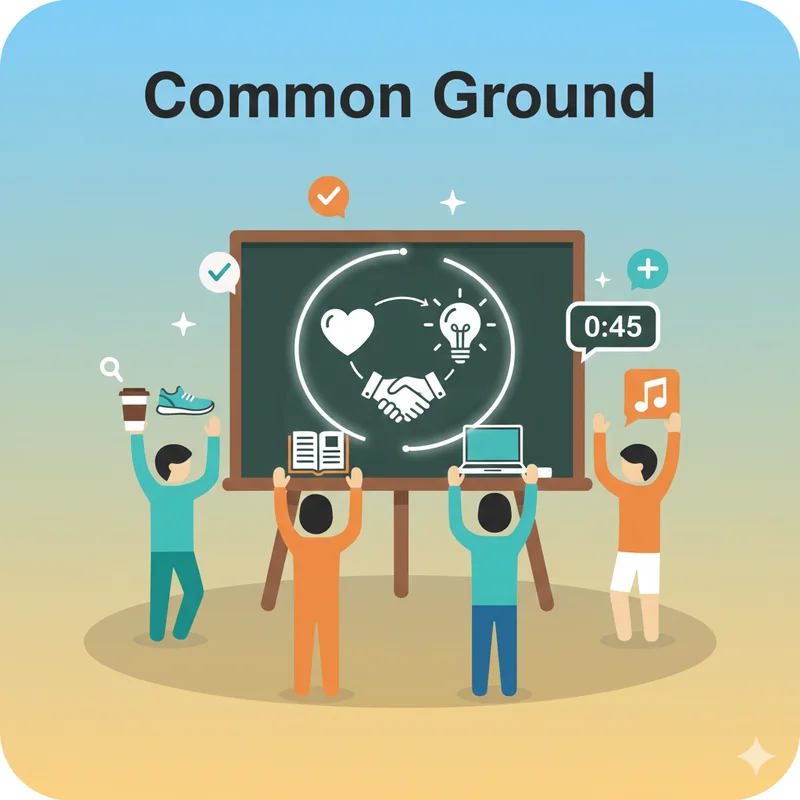
Groups find a set number of shared traits or experiences within a time limit, discovering unique commonalities.
✅ Why This Ice Breaker Game Works
- •This ice breaker has been used by 770 teams worldwide
- •Rated 4.9/5.0 by 101 facilitators who used this icebreaker game
- •Perfect ice breaker for: Team Building, Fun
📝 How to Play Common Ground Ice Breaker (Step-by-Step)
Step 1: Group Formation & Instructions
3 min💬 Say This:
"Welcome to Common Ground! Your mission: find things you all have in common. But here's the twist - we're looking for INTERESTING commonalities, not obvious ones. 'We all breathe' doesn't count! 'We all tried to dye our hair as teenagers and it went horribly wrong' - now that's interesting! I'm splitting you into [pairs/groups of 4/one big group]. You have [X] minutes to find [Y] things you ALL share. Ready? Go!"
📋 What to Do:
- 1.Decide on group size based on difficulty and team size:
- 2. - Pairs: easier, find 3-5 commonalities in 10 minutes
- 3. - Groups of 4-6: moderate, find 5-7 commonalities in 15 minutes
- 4. - Whole group: challenging, find 10 commonalities in 20 minutes
- 5.Split participants into groups accordingly
- 6.Explain the goal: find specific number of shared traits/experiences
- 7.Emphasize: look for UNIQUE, interesting commonalities
- 8.Give examples of good vs. bad commonalities:
- 9. BAD: 'We all have hair', 'We all breathe', 'We all work here'
- 10. GOOD: 'We all hate cilantro', 'We all played the same sport in high school', 'We all have visited the same country'
- 11.Distribute paper and pens to each group
- 12.Set timer and start
💡 Pro Tips:
- •The instructions are KEY - emphasize 'interesting' or you'll get boring lists!
- •Adjust difficulty by changing group size and number of commonalities: larger groups = harder
- •For virtual teams, use breakout rooms with collaborative docs for list-keeping
- •Some groups will finish early - challenge them to find more!
- •If a group struggles, give prompts: 'Where did you grow up?' 'What hobbies do you share?' 'Any food preferences in common?'
- •The activity works better with people who don't know each other well - more discoveries!
Step 2: Discovery Time
20 min💬 Say This:
"[Circulate among groups, listening and encouraging] 'Oh, that's a great one!' 'Keep digging - what else do you share?' [Give time warnings] '10 minutes left!' '5 minutes!' '1 minute to finalize your lists!' [At end] Time's up! How did everyone do? Did you find all [Y] commonalities? Who wants to share first?"
📋 What to Do:
- 1.Groups discuss and discover commonalities (main activity time)
- 2.As facilitator, circulate among groups:
- 3. - Listen to conversations (but don't interfere too much)
- 4. - Offer encouragement: 'Great find!' 'That's unique!'
- 5. - Gently redirect if commonalities are too generic: 'Can you get more specific?'
- 6.Give time warnings at intervals: halfway point, 5 minutes, 1 minute
- 7.If a group finishes early, challenge them: 'Can you find 3 more?'
- 8.Watch for interesting discoveries and note them for the sharing phase
- 9.When time's up, call everyone back together
💡 Pro Tips:
- •The magic happens in the conversations - let them unfold naturally
- •Listen for surprising commonalities to highlight during sharing: 'I heard one group all went to the same concert!'
- •If a group is stuck, offer categories: childhood experiences, travel, food preferences, hobbies, quirky habits
- •Some groups will bond quickly over shared experiences - that's the goal!
- •Watch for: laughter (they found something funny in common), surprise ('Wait, you too?!'), storytelling (they're going deeper)
- •Virtual: pop into breakout rooms briefly to check progress, but don't linger
Step 3: Sharing & Reflection
7 min💬 Say This:
"Alright, let's hear what you discovered! Each group, share your most interesting or surprising commonality. Group 1, what's one thing you all have in common that surprised you? [After each group shares] Wow! Anyone else share that trait? [After all groups share] What did you learn? Did any cross-group commonalities emerge? How does knowing these shared experiences change how you see your teammates?"
📋 What to Do:
- 1.Each group shares their list (or highlights) with everyone
- 2.Ask groups to focus on their most interesting or surprising commonality
- 3.After each share, ask: 'Does anyone else relate to this?' (find cross-group connections)
- 4.Celebrate unique finds: 'That's so specific!' 'What are the odds?'
- 5.Look for patterns: are there team-wide commonalities?
- 6.Facilitate discussion: 'What did you learn that surprised you?' 'How did this activity change how you see your teammates?'
- 7.Optional: compile a master list of all unique commonalities on a whiteboard
- 8.Thank everyone for participating and sharing
💡 Pro Tips:
- •The sharing is where individual group discoveries become team-wide connections
- •Listen for commonalities that span multiple groups - those are powerful team bonders
- •Great reflection questions: 'Did this exercise make you feel more connected to your teammates?' 'What commonality surprised you most?'
- •Point out: 'Even though we come from different backgrounds, we share more than we think!'
- •If there's time, ask: 'What's one thing you learned about someone that you didn't know before?'
- •For ongoing teams, create a 'Common Ground Board' displaying all the shared traits discovered
- •Follow-up: use discovered commonalities as conversation starters in future meetings
⚠️ Common Questions (Avoid Problems)
Q: What if a group can't find enough commonalities?
A: This can happen, especially with very diverse groups or large teams. If they're struggling: (1) Give them more time, (2) Allow them to find 'at least 2 people have this in common' instead of everyone, (3) Offer category prompts: childhood, travel, food, entertainment, quirky habits. The struggle itself is valuable - it highlights diversity and encourages creative thinking. If they truly can't reach the target number, celebrate what they DID find!
Q: How do we prevent people from listing boring, obvious commonalities?
A: Set the expectation upfront: 'We want INTERESTING commonalities!' Give examples of good vs. bad. As you circulate, gently redirect: 'Can you get more specific than that?' or 'What's a commonality that would surprise someone?' You can even add a rule: each commonality must make at least one person say 'Wait, really? Me too!' The goal is depth, not just a checklist.
Q: Can we play this activity multiple times with the same group?
A: Yes! Change the challenge each time: (1) First round: general commonalities, (2) Second round: focus on a specific category (childhood experiences only, travel only, etc.), (3) Third round: aspirational commonalities (places we all want to visit, skills we all want to learn). Or increase difficulty: find commonalities with the WHOLE team (harder) vs. just your small group. Fresh prompts keep it engaging.
🎁 Free Tools for This Game
💼 Need It Ready Faster? Pro Tools Save 3+ Hours
Everything above is free. These tools just save you time preparing.
PDF Handout
Print-ready participant guide + host notes
✓ Professional layout
✓ Branded (optional)
✓ Instant download
PPT Deck
Editable slides with rules & examples
✓ Fully customizable
✓ Add your branding
✓ Save as template
Smart Timer
Auto-paced with sound alerts
✓ Step-by-step timing
✓ Visual countdown
✓ Share screen ready
Adapt this game to your team culture, industry, or goals
Export clean files without FreeIceBreaker branding
Then just $9/month • Cancel anytime
⭐ 2,391 teams upgraded • "Saved me 3 hours every month" - Sarah K.